

Introduction
Deciding whether to sell the marital home before or after divorce ranks among the biggest financial choices couples face. Time it poorly, and you can forfeit a large share of the capital gains exclusion, prolong legal disputes, or end up in a pressured sale.
The home is usually the largest shared asset in the marriage. Sale timing affects your tax bill, how equity gets divided, and how soon each of you can move on.
This guide walks through:
- Why timing matters for taxes, equity, and the divorce timeline
- How to choose the right moment for your situation
- Signs you're ready to list—and mistakes that cost sellers money
- Fast-sale options when you need to close quickly and quietly
Key Takeaways
- Home sale timing directly affects your taxes, equity split, and stress levels during divorce
- Selling while still married can preserve a larger capital gains tax exclusion
- Weigh finances, spousal cooperation, market conditions, and kids' needs before you decide
- Waiting too long can trigger legal disputes, lost tax benefits, or a smaller final payout
- A fast, as-is cash sale lets you skip drawn-out negotiations when speed matters most
Why Timing Matters When Selling a House During a Divorce
For most divorcing couples, the house is the single biggest asset on the table. The timing of that sale, whether next month or next year, directly shapes each spouse's tax liability, their share of the equity, and how quickly both of you can move forward separately.
The Tax Exclusion at Stake
Under IRS Section 121, a qualifying individual can exclude up to $250,000 of capital gains from the sale of a primary residence. Married couples filing a joint return can exclude up to $500,000, according to IRS Publication 523.
That's not automatic, though. Both spouses generally need to meet ownership and use tests, and a divorce decree doesn't instantly wipe out eligibility.
The IRS even allows some flexibility: if one spouse moves out under a divorce or separation agreement while the other stays in the home, the departed spouse can often still count that time toward the residence requirement.
Filing status and timing relative to the decree both matter. Neither spouse should assume the exclusion size without checking their specific facts.
Carrying Costs Add Up Fast
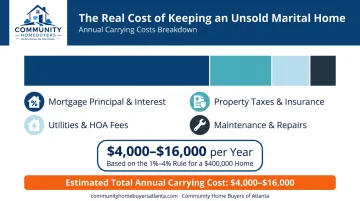
Every month the house sits unsold, someone is paying for it. That includes:
- Mortgage principal and interest
- Property taxes and homeowners insurance
- Utilities and HOA fees
- Ongoing maintenance and repairs
Fannie Mae's maintenance rule of thumb pegs annual upkeep at 1% to 4% of the home's value, depending on the property's age and condition, according to its homeowner maintenance budgeting guidance.
On a $400,000 Atlanta-area home, that's potentially $4,000 to $16,000 a year, on top of the mortgage itself.
The longer the house sits in limbo, the more it becomes a bargaining chip. Attorneys' fees climb. Frustration builds. And both spouses stay financially and emotionally tethered to a marriage they're trying to leave.
Best Time to Sell Based on Your Divorce Situation
There's no universal "best time" to sell a marital home. The right answer depends on your finances, your relationship with your soon-to-be ex, the local market, and whether kids are involved.
Based on Your Financial Situation
If neither spouse can comfortably cover the mortgage, insurance, and upkeep alone, waiting rarely helps. Selling sooner, often before the divorce is finalized, can prevent missed payments, foreclosure risk, or debt neither of you can absorb.
Selling earlier also makes sense when you need cash quickly for:
- Legal fees
- A security deposit on a new place
- A down payment on another home
When a drawn-out listing isn't realistic, a direct cash sale can give both of you speed and certainty without repairs or showings.
Based on Divorce Stage and Spousal Agreement
Cooperative spouses have more options. If both of you want a clean break and can agree on price and timeline, selling while still legally married often simplifies negotiations and cuts legal costs.
If the relationship is contentious, though, moving too fast can backfire. Wait until a court order or mediated agreement spells out how the sale will proceed and how proceeds will be divided.
Based on Market Conditions
Local market conditions matter. As of October 2025, metro Atlanta's housing market sat at a relatively balanced 4.4 months of supply, with a median sale price of $409,500 and nearly 19,757 active listings, according to the Atlanta Realtors Association's October 2025 market brief.
A tighter market with rising prices tends to favor selling sooner. A slower market with more inventory may reward patience, if there's no urgent financial pressure.
Based on Family and Children's Needs
Custody schedules and school calendars often override financial logic. If kids are settled in a particular school district or need consistency during an already disruptive time, delaying the sale until after the divorce can make sense, even if one spouse temporarily carries more of the housing cost.
Signs It's the Right Time to Sell — And When to Wait
Not every divorce situation calls for an immediate sale. Use the signs below to decide whether to move now or hold off.
Signs It's the Right Time
- Both spouses agree on the sale price, timeline, and how proceeds will be split
- Mortgage and maintenance costs have become unsustainable for either party to carry alone
- The divorce decree or settlement agreement requires liquid funds from the sale by a specific deadline
When You Should Wait
- One spouse wants to keep the house and needs time to arrange a refinance for a buyout
- Market conditions are temporarily soft, and there's no financial urgency forcing a sale
- Negotiations are highly contentious, and putting the house on the market now could hand one spouse extra leverage or become a delay tactic
If you're unsure which category fits your situation, that uncertainty itself is often a sign to loop in a divorce attorney before making a move. When carrying costs or a court deadline make speed essential, a direct cash sale can close without repairs, showings, or a long listing timeline.

What Happens If You Sell at the Wrong Time
Poor timing doesn't just cost money. It can create legal headaches that stretch the divorce process out even longer.
Losing the larger tax exclusion. If you sell after the divorce decree is final and file as single, you may only qualify for the $250,000 exclusion instead of the $500,000 available to married couples filing jointly. On a home with significant appreciation, that difference can mean a real tax bill.
Voided contracts and consent problems. Jointly owned marital homes typically can't be sold without both spouses' consent, or a court order authorizing the sale. In Georgia, pending divorce cases in counties like Fulton and DeKalb often fall under standing orders that restrict either spouse from selling or transferring shared property without agreement or court approval. Skip that step, and you risk a voided contract or a delayed closing.
Market timing risk. Rushing a sale to get out of the marriage in a volatile market can leave money on the table. Dragging the listing through a softening market while the settlement stalls can cost you just as much.
Overlooked details in the settlement. Divorce agreements frequently skip over practical questions tied to the sale itself, including:
- Who pays carrying costs while the home is listed
- How sale proceeds will be escrowed or held until settlement
- Who's responsible for repairs, inspections, or closing costs
Leaving these unresolved almost guarantees a dispute later, often right when both spouses are hoping to be done.
Best Practices for Timing Your Home Sale Correctly
Getting the timing right means coordinating the sale with the legal process, not leaving it to chance.
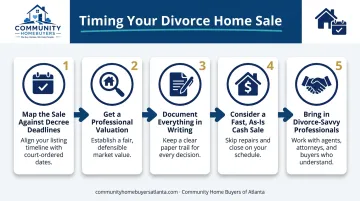
Map the sale against decree deadlines. Talk to your attorney early about settlement conference dates and decree deadlines, then bring in a real estate professional or cash buyer who can work within that window.
Get a professional valuation first. An appraisal gives both spouses accurate numbers to negotiate with, rather than guessing at the home's worth during settlement talks.
Document everything in writing. Keep records covering the agreed price, who's handling the listing (or sale), and exactly how proceeds will be divided. Verbal agreements tend to fall apart under pressure.
Consider a fast, as-is cash sale. For couples who need speed, a direct cash buyer like Community Home Buyers of Atlanta can deliver an offer within 24 hours and close in as little as 7 days.
- No repairs, showings, or public MLS listing
- Flexible closing dates that can match decree or settlement deadlines
- No lender contingencies that could derail a court-ordered timeline
Bring in divorce-savvy professionals. Mediators, agents experienced with divorce sales, or direct home buyers familiar with these situations keep negotiations business-like and cut the emotional friction that often stalls a sale.
Frequently Asked Questions
What happens if you sell a house before divorce?
Selling before the divorce is finalized generally lets both spouses use the full $500,000 married capital gains exclusion and split proceeds while still legally married. Proceeds should still be properly escrowed to avoid complicating the settlement later.
What often gets overlooked in divorce agreements about the house?
Common gaps include who covers carrying costs while the home is listed, how sale proceeds will be held until settlement, and who's responsible for repairs or closing costs. Spelling these out upfront prevents disputes later in the settlement.
Do I need my spouse's consent to sell the house during a divorce?
Yes, in most cases. Jointly owned marital homes typically require both spouses' consent, or a court order, before a sale can legally proceed.
Can I sell my house fast during a divorce to avoid a drawn-out process?
Yes. Cash home buyers can often close in as little as 7 days without repairs or showings, which can lower conflict and move the settlement forward faster.
How does capital gains tax work when selling a house during a divorce?
Married couples filing jointly can exclude up to $500,000 in capital gains, while individual filers are limited to $250,000. Sale timing relative to the divorce decree affects which exclusion applies.
What happens to the sale proceeds while the divorce is still pending?
Proceeds are typically held in escrow or a joint account until the settlement is finalized. Division follows what both spouses—or the court—agree to, not an automatic split at closing.