If you're researching this topic, you're probably weighing a real decision. Maybe you inherited a house you don't want. Maybe foreclosure is closing in, a divorce is forcing a quick sale, or bad tenants have turned your rental into a headache.
Whatever the situation, you're trying to figure out if selling to a company beats listing with an agent. This guide breaks down who these buyers actually are, how they calculate offers, what you gain and lose by selling to one, and how to spot a trustworthy buyer like Community Home Buyers of Atlanta versus one that isn't.
Key Takeaways
- Know the four buyer types before you sell: institutional investors, iBuyers, franchise networks, and local independent cash buyers
- iBuyers often net sellers 85–95% of market value after fees; franchise investors typically pay about 50–70% of repaired value
- Local cash buyers often best balance speed, transparency, and fair pricing on as-is or distressed homes
- Compare net proceeds—not the headline offer—and verify legitimacy before you sign
Who's Buying Single-Family Homes Today?
"Companies buying single-family houses" is shorthand for at least four very different business models. Despite headlines suggesting Wall Street owns your neighborhood, the numbers tell a different story.
A 2024 Census Rental Housing Finance Survey, summarized in a Congressional Research Service report, found that owners with 10 or fewer rental properties hold 75% of one-unit rentals nationwide. Entities owning more than 100 properties control less than 2%.
Institutional buyers own the headlines more than the market share. Their holdings also cluster unevenly, and Atlanta is one of the clearest hotspots.
Institutional Investors and Wall Street Landlords
These are publicly traded or private-equity-backed companies that buy homes by the thousands and manage them like scattered apartment complexes. The biggest names include:
- Invitation Homes (NYSE: INVH): over 85,500 wholly owned homes plus roughly 8,000 joint-venture properties
- American Homes 4 Rent / AMH (NYSE: AMH): about 61,000 properties in its portfolio
- Progress Residential: a Pretium subsidiary managing more than 90,000 rental homes across 30-plus markets
Atlanta has been a favorite target for these operators. Urban Institute research found institutional investors held 28.6% of Atlanta's single-family rental stock. Mega investors (1,000+ homes) accounted for roughly a quarter of that share, one of the highest rates of any major U.S. metro.
iBuyers (Technology-Driven Instant Offer Companies)
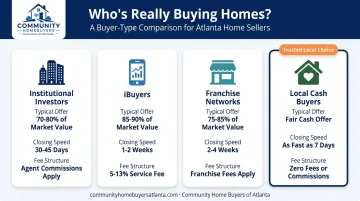
iBuyers like Opendoor and Offerpad use automated valuation models to generate an offer almost instantly, often within 24-48 hours of submitting your address online.
Here's how the math typically works:
- Offers generally land at 85-95% of market value
- Opendoor charges a service fee around 5%, plus 1-3% in closing costs
- Offerpad charges roughly 5% plus about 1% in closing costs
The catch? iBuyers are picky. They generally exclude homes with major foundation issues, extensive fire or water damage, and older properties in some markets. If your house needs serious work, an iBuyer probably isn't an option.
Franchise Investor Networks
Franchise networks like HomeVestors ("We Buy Ugly Houses") and We Buy Houses operate through independently owned local franchisees using shared branding and valuation software.
The typical formula starts with after-repair value (ARV), then subtracts repair costs and the franchisee's margin. Offers generally land around 50-70% of ARV.
There's usually no service fee, but the price is lower than an iBuyer or open-market sale. This model fits genuinely distressed properties: fire damage, hoarder situations, or homes needing a full gut renovation. Quality varies a lot between franchisees since each office runs independently.
Local, Independent Cash Home Buyers
Local, family-owned buyers operate differently from national networks. There's no franchise fee structure, no call center routing, and no corporate buy-box dictating what they'll consider.
Community Home Buyers of Atlanta is a good example. As an independently owned company, they:
- Buy directly with their own cash: no MLS listing, no investor network handoffs
- Base offers on local Atlanta comps, condition, and needed repairs rather than a generic formula
- Provide a single point of contact throughout the transaction
- Focus specifically on Atlanta, Decatur, Forest Park, and Jonesboro instead of dozens of scattered markets
That local focus tends to produce offers that reflect what's happening in your actual neighborhood, not a nationwide algorithm.
Why Are Companies Buying So Many Single-Family Homes?
The buy-to-rent industry barely existed before the 2008 financial crisis. Foreclosures flooded the market with cheap, scattered houses, and large investors realized they could renovate and rent them at scale, something once too costly to manage.
No investor owned 1,000+ single-family rentals in late 2011. By 2015, institutional investors collectively held an estimated 170,000 to 300,000 homes.
Two forces have kept that engine running:
Affordability pressure. Rising mortgage rates have priced out a growing share of would-be buyers, pushing more households toward renting single-family homes instead of apartments. That demand has kept investors active: they bought roughly 31% of single-family homes purchased in December 2025, a mix of small, medium, large, and mega buyers.
Technology. Tools that once required boots on the ground now run at scale:
- Automated valuation models price hundreds of homes without an interior walkthrough
- Cloud-based property management handles rent collection and maintenance remotely
- Virtual tours cut down on in-person showings before purchase
Together, these tools turned buying scattered homes from a logistical nightmare into a scalable business.
How Much Will a Company Pay for Your House?
The honest answer: it depends entirely on which type of buyer you're dealing with.
- iBuyers: roughly 85-95% of market value, minus a 5-8% service fee and closing costs
- Franchise investors: roughly 50-70% of after-repair value, with no service fee but a bigger built-in discount
- Local cash buyers: no fixed formula — offers are based on your home's condition, needed repairs, and recent comparable sales in your area
Community Home Buyers of Atlanta, for example, evaluates four factors before making an offer: location, current condition, repairs needed, and recent comps from nearby sales.
They deliver a cash offer within 24 hours. Because they cover closing costs and charge no commissions, the number they quote is the number you walk away with.
Offer Price Isn't the Same as Net Proceeds
This trips up a lot of sellers. A higher offer on paper doesn't always mean more cash in your pocket. Say you get two offers on a $200,000 house:
| Line item | iBuyer Offer | Local Cash Buyer Offer |
|---|---|---|
| Gross offer | $190,000 | $160,000 |
| Service fee (6%) | -$11,400 | $0 |
| Closing costs | -$4,000 | $0 (covered by buyer) |
| Repair credits | -$3,000 | Already factored in |
| Net to seller | $171,600 | $160,000 |
The iBuyer nets more here, but the gap shrinks fast once fees, credits, and repair negotiations get factored in.
Always get more than one offer. Roughly 26% of all U.S. home purchases in the past year were paid in cash, according to NAR's 2025 Profile of Home Buyers and Sellers, so cash buyers are common enough that you have real options to compare.
Faster closings and as-is purchases usually mean a lower headline price than a full open-market listing. Compare every offer on net proceeds, not the number at the top of the page.
Pros and Cons of Selling to a Company That Buys Houses
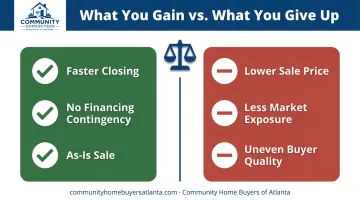
Selling to a cash home buyer is a tradeoff: you gain speed and certainty, and you usually give up top-of-market price. Here’s how the two sides break down.
Advantages vs. Drawbacks
What you gain:
- Speed: closings in as little as 7 days, versus the 47-62 days typical for a traditional listing
- Certainty: no financing contingency, so the deal doesn’t fall apart if a buyer’s mortgage fails
- As-is sale: skip repairs, cleaning, staging, and back-to-back showings
What you give up:
- A lower sale price than you might net on the open market, especially for move-in-ready homes
- Less market exposure, so you won’t collect multiple competing offers
- Uneven buyer quality: national franchise offices vary by location, while local direct cash buyers tend to run a more consistent process
Those tradeoffs point to a clear fit for some sellers and a poor fit for others.
Who Benefits Most
A company sale tends to make the most sense if you're facing:
- Pending foreclosure or missed mortgage payments
- Probate or an inherited property you don't want to manage
- Divorce and a need to split proceeds quickly
- A rental with problem tenants you don't want to evict yourself
- Fire, storm, or water damage you can't afford to fix
If your home is move-in ready and you're in a competitive seller's market, listing with an agent is usually still the better play. Maximizing price matters more than speed in that case, and multiple offers can net thousands more than a quick cash sale, even after commissions.
How to Choose the Right Company to Sell Your House To
Not every cash home buyer works the same way. A few checks separate fair local buyers from operators who rush you into a weak offer.
Due Diligence Checklist
Before you sign anything:
- Verify proof of funds — a legitimate cash buyer can show bank statements or a letter from their financial institution
- Check BBB ratings and online reviews — look for patterns in complaints, not just star counts
- Request a written, itemized offer breakdown — you should understand exactly how they arrived at the number
Red Flags to Watch For
Walk away if you notice:
- High-pressure tactics pushing you to sign within hours
- Vague "no fees" claims hiding a below-market offer in the fine print
- Refusal to explain how they calculated your offer
A Local, Transparent Option
Community Home Buyers of Atlanta is a family-owned cash buyer serving Atlanta, Decatur, Forest Park, and Jonesboro—an alternative to national investor networks. Sellers can expect:
- Cash offers within 24 hours of submitting property details
- Closing in as little as 7 days, or on a timeline you choose
- Zero commissions, zero fees, and the company covers closing costs
- Offers based on four factors: location, condition, needed repairs, and local comps
- Direct communication with your mortgage lender if you face foreclosure
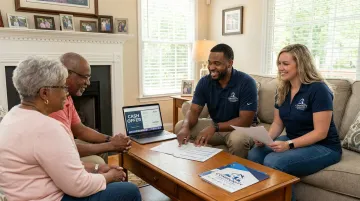
Want a local comparison before you commit to a national franchise or iBuyer? Request a no-obligation cash offer from Community Home Buyers of Atlanta. It costs nothing and takes a few minutes.
Frequently Asked Questions
How much will an investor pay for a property?
Franchise investors often offer about 50–70% of after-repair value. iBuyers may go as high as 85–95% of market value. Local cash buyers set the number based on condition and repair needs.
What percentage of single-family homes are owned by institutional investors?
Census data shows entities owning more than 100 rental properties control less than 2% of one-unit rentals nationwide. Small owners with 10 or fewer properties still own about 75% of the market.
Are "We Buy Houses" companies legitimate?
Most are legitimate, but quality varies by franchisee because each office operates independently. Always verify proof of funds and check reviews before signing.
How fast can a company buying houses close on my property?
Most cash-buying companies can close in 7-14 days, compared to 30-60 days or more for a financed sale. Some, like Community Home Buyers of Atlanta, can close in as little as 7 days.
Do I need to make repairs before selling to a cash home buyer?
No. Most cash buyers, including local investor buyers, purchase homes as-is with no repairs, cleaning, or staging required before closing.
Is it better to sell to a company or list with a real estate agent?
It depends on your priorities. Agents can often net a higher price but take longer and add more uncertainty. Cash buyers trade some price for speed, certainty, and an as-is sale.