

Introduction
Divorcing couples often struggle with one make-or-break financial decision: what happens to the house. It's often the largest asset either spouse has ever owned, and it carries decades of memories along with the mortgage payments.
Selling sounds simple enough. In practice, the outcome depends on your state's property laws, how cooperative you and your spouse remain, and which sale method you choose.
This guide walks through the essentials:
- Who typically gets the house in a divorce settlement
- The step-by-step process for selling during a divorce
- The best time to list the property
- Legal and tax factors that shape your outcome
- Common mistakes to avoid
- Alternatives if selling outright isn't the right fit
Key Takeaways
- Four paths exist for the marital home: sell and split proceeds, buyout, co-own, or trade for other assets
- Georgia uses equitable distribution, not automatic 50/50 splits, so how the home is titled and funded matters
- Timing your sale affects your capital gains tax exclusion and how much court involvement you'll need
- A written agreement on pricing, repairs, and agent selection prevents most disputes before they start
- Choosing a cash buyer can remove showings, repairs, and drawn-out negotiations from an already stressful process
How to Sell a House During a Divorce: Step-by-Step
Step 1: Get Legal Clarity Before Listing
Talk to a family law attorney before you list anything. You need to know whether the house counts as marital or separate property, and whether an Automatic Temporary Restraining Order (ATRO) applies to your case.
Many counties, including Fulton and DeKalb, issue standing orders the moment a divorce is filed. These orders typically restrict selling, transferring, or encumbering property without written consent or court approval.
Once you know where you stand legally, get the sale terms in writing:
- Target price range
- Timeline expectations
- How proceeds will be split
- Who signs off on offers
Put this into a settlement agreement or temporary court order. Verbal agreements fall apart fast once emotions run high.
Step 2: Get the Home Valued
A professional appraisal gives you a defensible number both spouses and the court can rely on. A comparative market analysis (CMA) from an agent is useful for a quick gut-check, but it isn't a substitute for a licensed appraisal when equity or a buyout is on the line.
This valuation becomes the foundation for:
- Calculating each spouse's equity share
- Setting a fair buyout price
- Negotiating asset trades in place of a sale
Skip this step and you're negotiating on guesswork.
Step 3: Agree on Repairs, Prep, and Listing Strategy
Decide together whether you're fixing up the house or selling as-is. Disagreements over repair costs are one of the most common reasons divorce-related home sales stall.
Ask yourselves:
- Who pays for repairs, and how is that cost recouped from proceeds?
- Are you staging the home, or listing it as-is?
- Who has final say on listing price?
- What's the target closing or listing date?
If you can't agree here, the rest of the process gets harder. This is where many couples start looking at faster, lower-conflict alternatives.
Step 4: Choose How You'll Sell — Agent Listing vs. a Direct Cash Sale
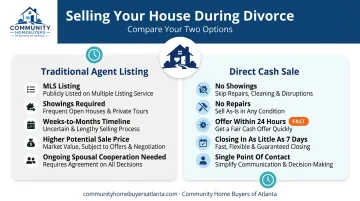
The traditional route means hiring a neutral real estate agent, listing on the MLS, and managing showings and offers together. It can net a higher sale price, but it also requires ongoing cooperation on pricing, repairs, and buyer negotiations for weeks or months.
The alternative: sell directly to a local cash home buyer. Community Home Buyers of Atlanta, for example, provides a cash offer within 24 hours of reviewing the property and can close in as little as 7 days. There's no staging to agree on, no showings to coordinate, and no back-and-forth with buyer financing contingencies.
This route tends to work well when:
- Spouses want to limit how much they need to jointly manage
- The home needs repairs neither party wants to fund
- Both parties want the sale finished quickly, not dragged out over a season
Step 5: Close and Divide the Proceeds
At closing, proceeds first cover the mortgage payoff and closing costs. What's left gets divided according to your settlement agreement or court order.
Get the split confirmed in writing, especially if the divorce isn't finalized yet. A closing or settlement statement from the title company will itemize the payoff and net proceeds. Keep a copy. Disputes over "who got what" are far easier to resolve with paperwork than with memory.
When Should You Sell: Before, During, or After Divorce?
Timing changes your tax treatment, how much court involvement you'll need, and how complicated the logistics get. There's no universal right answer.
Selling Before the Divorce Is Finalized
Selling while still legally married and filing jointly may qualify you for the full $500,000 capital gains tax exclusion under IRS Publication 523, compared to the $250,000 exclusion available to single filers. It typically requires less court intervention too, since both spouses are still legal co-owners with full authority to sell without needing a judge's sign-off.
Selling During the Divorce Process
Mid-divorce sales usually require court approval or written spousal consent because of ATROs (Automatic Temporary Restraining Orders), which freeze major asset transfers once a divorce petition is filed. This adds a layer of delay and often means looping in your attorneys before you can even sign a listing agreement.
A direct cash sale can simplify this step. Once you have the required consent or court order, a buyer like Community Home Buyers of Atlanta can close in as little as 7 days, well inside a typical 30-45 day escrow window.
Selling After the Divorce Is Final
Once divorced, each spouse typically qualifies only for a $250,000 individual exclusion, according to IRS Publication 523. This exclusion generally requires living in the home for at least 2 of the last 5 years before the sale.
A spouse who moved out years earlier may lose eligibility entirely if the sale happens outside that ownership-and-use window, unless a divorce or separation instrument grants an exception.
Key Factors That Affect Your Home Sale During a Divorce
Marital vs. Separate Property and State Division Rules
Marital property generally includes anything acquired during the marriage, regardless of whose name is on the title. Separate property covers what one spouse owned before marriage or received individually as a gift or inheritance.
Separate property doesn't always stay separate. If both spouses contributed to mortgage payments or renovations, it can become partially marital.
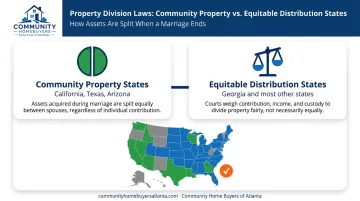
How that property gets divided also depends on where you live. Community property states like California, Texas, and Arizona typically split marital assets 50/50, but Georgia isn't one of them.
Georgia follows equitable distribution, meaning courts divide marital property "fairly," not necessarily equally. In Stokes v. Stokes, the Georgia Supreme Court upheld a 75/25 split based on each spouse's contribution, not a straight-down-the-middle division. Income, custody arrangements, and each spouse's contributions all factor into the outcome.
Capital Gains Tax Implications
To qualify for the Section 121 exclusion, you typically must have lived in the home for at least 24 months out of the 5 years before the sale. Move out, and that window keeps ticking, which is why sellers often talk about a rough "three-year rule" after separation.
There's an important exception: if a divorce or separation agreement allows one spouse to keep living in the home, that occupancy can count toward the other spouse's use requirement too.
Court-Ordered (Forced) Sales
Georgia courts rarely force a sale unless the property can't be fairly divided any other way. Under Georgia Code § 44-6-160, a partition action allows a co-owner to petition the court for sale when a fair division "in kind" isn't possible.
If one spouse won't cooperate, mediation usually comes first. Only after that fails does a judge typically step in, and uncooperative behavior can sometimes work against that spouse in the final ruling.
Common Mistakes to Avoid When Selling a House During Divorce
Even amicable divorces run into avoidable home-sale problems. Watch for these:
- Pricing out of spite: Rejecting fair offers or setting an unrealistic price to punish the other spouse only delays everyone's payout.
- Skipping written agreements: Verbal understandings about repairs, cost-splitting, and agent selection tend to unravel under stress.
- Missing the tax exclusion window: Delaying the sale past your eligibility period can cost tens of thousands in avoidable capital gains tax.
- Letting mortgage payments slide: Missed payments during the sale process damage both spouses' credit and can derail the deal entirely.
Alternatives to Selling Your House During a Divorce
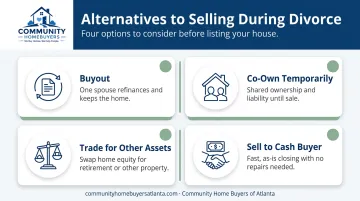
A sale isn't the only path forward. Some couples land on a better financial or emotional outcome with one of these options instead.
One Spouse Buys Out the Other
The remaining spouse typically refinances the mortgage into their own name, paying the other spouse their equity share. This option comes with a few conditions:
- The remaining spouse must qualify for the loan solely on their own income
- A title transfer alone doesn't release the departing spouse from mortgage liability
- Lender approval through refinancing or an assumption process is required
Co-Owning the Home Temporarily
Some couples keep the house jointly for a set period, often to give kids stability through a school year. This keeps both spouses financially tied to the property, including liability if payments are missed.
Trading the Home for Other Assets
Couples with multiple valuable assets, retirement accounts or a second property, for instance, sometimes let one spouse keep the house while the other takes assets of equal value. This works best with a solid appraisal backing up the math.
Selling Directly to a Cash Home Buyer
For couples who want a clean, fast exit without repair costs or commissions, selling directly to a company like Community Home Buyers of Atlanta is a practical middle ground.
The company buys homes as-is and covers closing costs. Both spouses can walk away with their share of proceeds faster than a traditional listing allows, without agreeing on staging, showings, or buyer negotiations.
Frequently Asked Questions
Who gets the house in a divorce?
It depends on whether the home is marital or separate property, your state's division laws, and any prenuptial or postnuptial agreements. In Georgia, courts divide property equitably rather than automatically 50/50.
Can the court force the sale of a house during divorce?
Yes, but only after determining the property can't be fairly divided any other way. Georgia's partition statute allows this when spouses can't reach an agreement on their own.
What happens if one spouse refuses to sell the house?
Mediation is typically attempted first. If that fails, a judge can order the sale and may factor the uncooperative spouse's delays into the final ruling.
How long do you have to sell the house after a divorce?
Timelines are usually set in the divorce decree itself. Separately, the IRS generally requires the sale to happen within a window tied to your last two years of residency to keep your capital gains exclusion.
Do you have to pay capital gains tax when selling a house during divorce?
If you sell before the divorce is final and file jointly, you may qualify for a $500,000 exclusion. After divorce, each spouse typically qualifies for a $250,000 individual exclusion, assuming residency requirements are met.
Is it better to sell a house before or after divorce is finalized?
Selling before finalization often preserves the larger joint tax exclusion and requires less court involvement. The right choice still depends on how well you and your spouse can cooperate and how quickly you need the sale done.