Many of these sellers aren't chasing top dollar. They're dealing with foreclosure, an inherited property tangled in probate, a divorce that needs a clean split, or a rental with tenants who've stopped paying. For them, speed and certainty matter more than squeezing out every last dollar.
This guide walks through the exact process for selling your house for cash in 2026: the step-by-step timeline, when a cash sale actually makes sense, what pushes your offer up or down, and the mistakes that can cost you money before you ever sign a contract.
Key Takeaways
- Close in 7–14 days instead of the 30–60+ days common with a traditional listing.
- Expect offers below full retail value—but skip repairs, commissions, and holding costs.
- Local buyers like Community Home Buyers of Atlanta can offer in 24 hours and close on your date.
- Always confirm proof of funds and BBB status before signing anything.
How to Sell Your House for Cash in 2026 (Step-by-Step)
Selling for cash follows a short path: get an offer, confirm condition, agree on terms, clear title, and close. Most sellers can get a number within 24 hours and pick a closing date as soon as 7 days out.
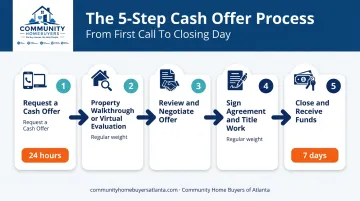
Step 1: Request a Cash Offer
Start by submitting your property details online or by phone. Most direct buyers, including Community Home Buyers of Atlanta, ask for just the basics: your address, phone number, email, and a few comments about the property's condition or situation.
There's no cost and no obligation to this step. Companies typically respond with a cash offer within 24 hours of receiving your information.
Before you submit, decide whether you're selling strictly as-is or open to handling minor repairs yourself. This affects how the buyer frames their number and how quickly they can move.
Step 2: Schedule a Property Walkthrough or Virtual Evaluation
Next, the buyer looks at the home in person or remotely to confirm condition, estimate repair costs, and pull comparable local sales.
This isn't like prepping for a traditional open house. Most cash buyers evaluate homes as-is, including:
- Fire-damaged or storm-damaged homes
- Cluttered or hoarder situations
- Tenant-occupied rentals
- Homes with deferred maintenance or code violations
No deep cleaning, staging, or repairs required before this step.
Step 3: Review and Negotiate the Offer
Once you have a number, compare it to your home's estimated market value. Subtract liens, back taxes, and any remaining mortgage so you can see true net proceeds versus a traditional listing.
Before signing anything:
- Request a written proof-of-funds letter confirming the buyer can close.
- Ask directly who pays closing costs (some buyers cover them entirely).
- Get clarity on any service fees buried in the fine print.
Step 4: Sign the Agreement and Complete Title Work
Once you accept, a title company or attorney runs a title search to confirm the property can transfer free of judgments or competing claims.
If you're behind on payments or facing foreclosure, an experienced local buyer can work directly with your lender at this stage. Community Home Buyers of Atlanta, for example, coordinates with the bank on your behalf so the payoff at closing can stop foreclosure proceedings.
Step 5: Close and Receive Your Funds
Pick a closing date that fits your timeline. That could mean as little as 7 days if you need to move fast, or longer if you need time to relocate.
At closing, funds are wired directly to your account. There are no agent commissions or listing fees, and reputable cash buyers often cover closing costs so nothing extra comes out of your total.
When Should You Sell Your House for Cash?
A cash sale isn't the right move for every seller. It works best when speed and certainty outweigh squeezing out the highest possible price.
Common situations where it makes sense:
- Foreclosure: need to close before an auction date
- Inherited or probate property: want to liquidate without managing repairs from a distance
- Divorce: need a fast, clean split of assets
- Job relocation: can't wait months for a buyer while starting a new position
- Problem tenants: landlord fatigue from non-paying or damaging renters
- Major repairs needed: fire, water, or structural damage that's too costly to fix before listing
A traditional listing can still win if your home is move-in ready in a competitive, high-demand neighborhood—multiple offers may net you more money. Cash buyers are built for speed and problem properties, not bidding wars.
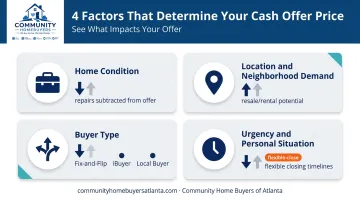
Key Factors That Affect Your Cash Offer Price
Cash offers vary by property and buyer. Several variables shape the final number, and knowing them helps you judge whether an offer is fair.
Home Condition
Why it matters: Estimated repair costs get subtracted from the offer amount before you ever see a number.
Impact on price: Move-in-ready homes land closer to market value. Homes needing major work, like a new roof or foundation repair, see steeper discounts because the buyer has to budget for that renovation.
Location and Neighborhood Demand
Why it matters: Buyers factor in resale or rental potential for the surrounding area, not just the house itself.
Impact on price: In metro Atlanta, neighborhoods like Decatur, Forest Park, and Jonesboro tend to attract stronger offers thanks to steady buyer demand and healthy comparable sales.
Buyer Type (Fix-and-Flip, iBuyer, or Local Direct Buyer)
Each type prices differently:
| Buyer type | How they price | What that means for you |
|---|---|---|
| Fix-and-flip investor | 70% rule: ARV × 0.70 − repairs | $300K ARV, $50K repairs → ~$160K max offer |
| iBuyer | Algorithmic pricing models | Often a few points below recent comps |
| Local direct buyer | Condition, location, and comps | Case by case; no fixed percentage |
The 70% rule comes from Investopedia's flipping guide. It is an underwriting formula, not a guaranteed payout from every buyer type. NBER research found iBuyers paid about 3.6 percentage points less than comparable sales—roughly $9,000 on an average home in their sample.
Urgency and Personal Situation
Why it matters: Deadlines tied to foreclosure or tax liens shape your negotiating leverage and how much timeline flexibility you have.
Impact on price: Reputable local buyers structure offers and closing dates around your specific hardship rather than penalizing you for it. Community Home Buyers of Atlanta, for instance, will accommodate a court-mandated deadline or slow things down if you need more time to make arrangements.
Common Mistakes to Avoid When Selling for Cash
Even a fast sale deserves due diligence. Watch for these missteps:
- Accepting the first offer blindly: get an independent market value estimate or a second opinion before you sign.
- Skipping buyer verification: request proof of funds and check BBB accreditation before handing over any paperwork.
- Ignoring the fine print: confirm who pays closing costs and whether any service fees or contingencies could quietly shrink your net proceeds.
A legitimate buyer won't hesitate to answer these questions. If they dodge them, treat it as a red flag and pause the deal.
Cash Sale vs. Traditional Listing: Which Is Right for You?
The right path depends on your priorities: speed and certainty, or maximum sale price.
| Factor | Selling for Cash | Traditional Agent-Listed Sale |
|---|---|---|
| Best for | Distressed situations, tight timelines, homes needing repairs | Move-in-ready homes in competitive markets |
| Timeline | 7–14 days | 30–60+ days |
| Commissions/fees | Typically none | Up to 6% agent commission plus ~2% closing costs |
| Price outcome | Usually below market value | Potential for higher net proceeds through competing offers |
| Repairs required | None | Often needed to compete |
How to choose:
- Go cash when timeline, repairs, or a life event (foreclosure, probate, divorce, relocation) matters more than top dollar
- List traditionally when the home is show-ready and you can wait 30–60+ days for competing offers
Research from UC San Diego's Rady School of Management found that all-cash buyers pay about 10% less on average than mortgage-backed buyers across 2 million transactions. That gap is the trade-off: less money for speed, fewer contingencies, and no risk of financing falling through.
Frequently Asked Questions
What is the most profitable way to sell my house?
Listing with an agent on the open market typically yields the highest sale price since multiple buyers can compete. A cash sale trades some of that profit for speed and certainty.
Is selling my house for cash a good idea?
Yes—if you value speed and certainty over top dollar. You close faster with fewer contingencies, but usually at a lower price than a full market listing.
How fast can I close when selling my house for cash?
Most cash sales close in 7–14 days. Compare that to 30–60+ days for a financed, agent-listed sale.
Do cash home buyers pay closing costs?
Many reputable cash buyers, including Community Home Buyers of Atlanta, cover closing costs as part of their offer. The number you're quoted is typically the number you receive.
Are cash-for-houses companies legit?
Many are. Before you sign, verify proof of funds, read recent reviews, and confirm BBB status.
How much less will I get selling my house for cash compared to market value?
It varies by condition, location, and buyer type. As a benchmark, UC San Diego research found all-cash buyers pay roughly 10% less than mortgage-backed buyers on average.